 Timing & payouts desk
Withdrawal Speed Comparison: Which Online Casinos Pay Out the Fastest?

Crypto is the fastest way to get paid, e-wallets come next, and card or bank-wire withdrawals are the slowest. But the method only explains part of the gap between two casinos that look identical on paper. The bigger reason payout speed varies so much is that no regulator sets a deadline. Kahnawake, Ontario’s AGCO and Curaçao’s new CGA all require casinos to pay you, but none of them says how many days that can take. So the only number worth trusting is the one the operator publishes itself.
Method sets the floor. The operator’s own stated timeframe sets the ceiling, and it’s the part you can actually check before you deposit.
How a Withdrawal Actually Moves Through the System
Every cashout passes through three phases, and they don’t overlap.
Phase one: pending review. Your request sits in a queue while the casino decides whether to release it. This is where bonus wagering requirements get checked, and where a pending window of a few hours to a day or more is common at operators that build one in deliberately. Some casinos let you cancel a pending withdrawal during this window. That sounds helpful until you realise it’s also a cooling-off period designed to keep the money in play.
Phase two: KYC and internal processing. Once the request clears review, the casino verifies who you are and pushes the payment out its side. If your documents are already approved, this is fast. If they aren’t, a manual review commonly adds another day or three. This is the phase most players underestimate, because it happens after the casino has already accepted the request.
Phase three: payment-network transfer. The casino has released the money. Now the payment rail decides how long it takes to land. Crypto settles in minutes. Interac e-Transfer is close to real time. Card networks batch their settlement, which is why a card withdrawal can sit for days after the casino says it’s done.
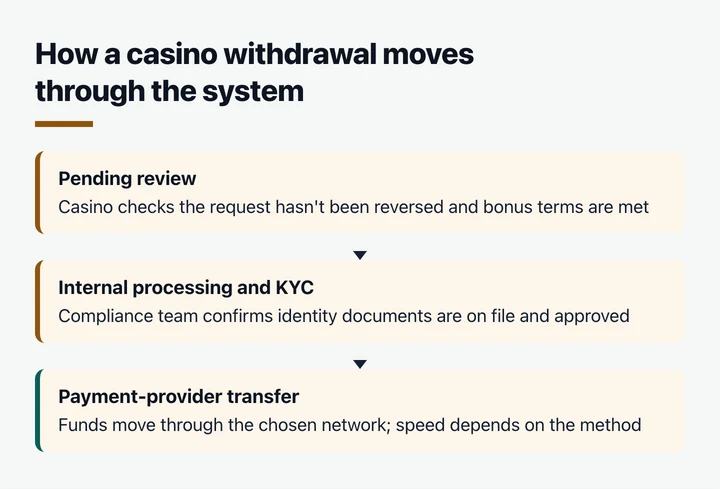
When a casino quotes “up to 5 business days,” it’s usually describing phase three while quietly including phases one and two in the same number.
Payout Speed by Method
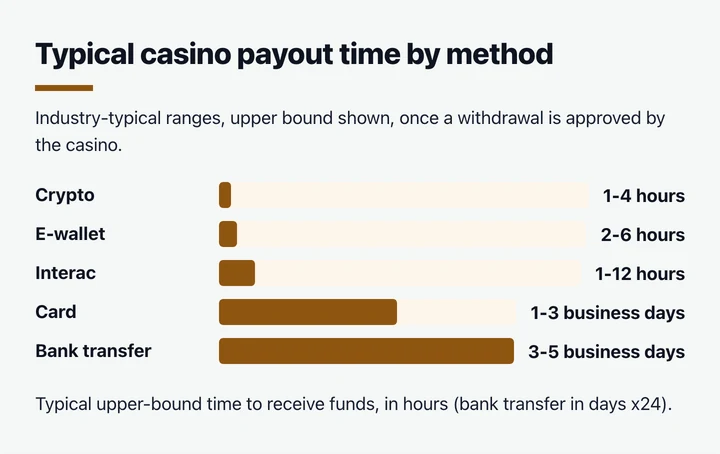
Payment method is the strongest predictor of speed across licensed operators. What changes is how much of the total time each method eats.
| Method | Typical casino-side release | Typical network transfer | Realistic total |
| Crypto (BTC, ETH, USDT) | 1–4 hours | Near-instant | Same day |
| E-wallets (Skrill, Neteller) | 2–6 hours | Minutes | Same day |
| Interac e-Transfer | Varies by operator | Real time to 3–5 business days | Hours to a week |
| Card / bank wire | 1–5 business days | Batch settlement | Several days |
Crypto wins because it skips the banking system entirely. The casino approves, broadcasts, and the blockchain confirms. The 1–4 hour range is casino-side approval, because the transfer itself is close to instant.
E-wallets are the next best option and the one most players should default to. Skrill and Neteller typically release within 2–6 hours after the casino approves, and the wallet-to-bank leg is quick. Support varies by operator. Not every casino supports both wallets, and some pass a withdrawal fee to the player.
Interac is the Canadian-specific answer, and it processes in real time including evenings and weekends, with a notification delay of up to 30–45 minutes when the recipient is enrolled with a participating institution. If your deposit account isn’t at a participating institution, or isn’t enrolled in online banking, the same transfer can take 3–5 business days. Some banks also apply their own fraud holds regardless of the hour. So Interac is fast when everything lines up and slow when one link in the chain doesn’t.
Cards and bank wires are the slowest, and the cause is structural: card networks settle in batches, and bank wires move through correspondent banking. A 1–5 business day range is normal, and it can stretch if a weekend or holiday falls in the middle.
If you want to see how individual operators stack up on these methods, a ranked casino list is a reasonable starting point, but read each operator’s own withdrawal page before you trust any ranking.
Why No Regulator Actually Guarantees a Payout Deadline
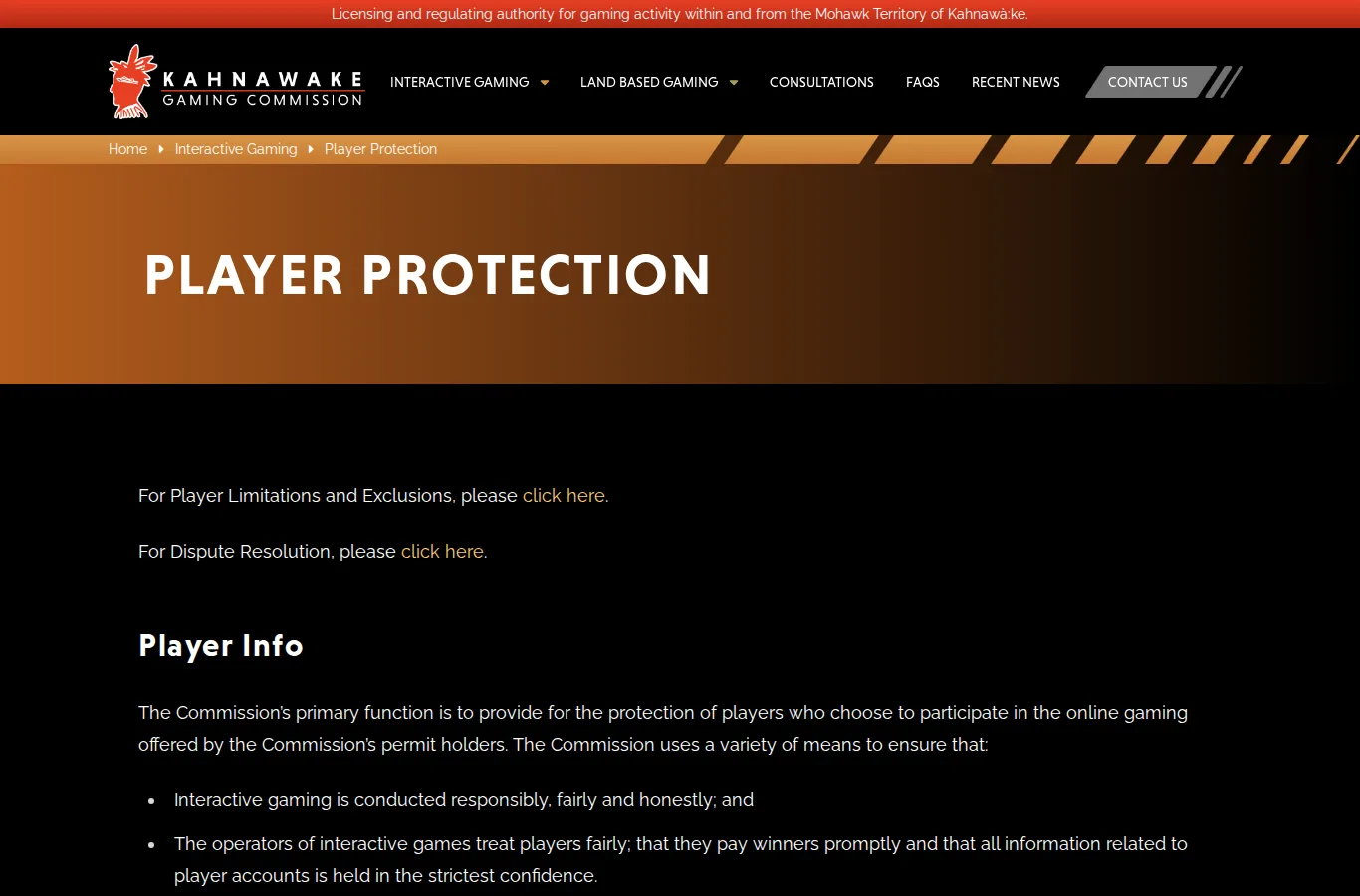
Kahnawake requires licensees to keep player funds in accounts segregated from operational finances, and requires identity verification before withdrawals are processed as a standard anti-fraud measure. If a payout dispute isn’t resolved by the operator, players can file a formal complaint directly with the KGC compliance body, transaction records and all. What Kahnawake does not do is set a number of days within which a withdrawal must be paid.
Ontario’s AGCO goes a step further in language and still stops short of a number. Its iGaming Standards require that players be permitted to withdraw funds accurately and completely, “as soon as is practicable” and “within a reasonable timeframe,” subject to authorization and verification. That’s a real obligation. It is also explicitly not a fixed timeframe, so the standard names no number of days and there is no fixed deadline an operator could miss.
Curaçao changed its licensing structure in January 2025. The old Master License and sub-license hierarchy was fully dismantled, and every sub-license expired that month. The new Curaçao Gaming Authority is now the single, direct regulator and licensor, replacing the four former Master License Holders that previously issued sub-licenses with little centralised oversight. That reform makes a single authority directly accountable for every operator it licenses. It is not a payout SLA, since the reform changes licensing structure and oversight, not payout speed.
Regulators require casinos to pay you. None of them requires a casino to pay you within a set number of days. That gap is why a casino’s own published timeframe is the only commitment you can hold it to, and why comparing operators on their stated numbers is more useful than comparing them on licence logos.
What Actually Delays a Withdrawal
Four things cause most of the delay, and only one of them is the casino being slow on purpose.
Per-transaction caps. Many operators cap a single withdrawal at a figure well below your balance. If you’re cashing out more than the cap, you need multiple requests, and each one goes through the queue separately. A $5,000 balance against a $2,000 per-transaction cap is three withdrawals, not one.
Active bonus wagering. If you have an unfinished bonus, the withdrawal is locked until the wagering requirement is met. The bonus wagering requirement holds the request in place until it’s cleared. Read the bonus terms before you deposit, not after you win.
Weekend and holiday gaps. Crypto and Interac run around the clock. Card networks and banks don’t. A request approved Friday evening on a card rail may not move until Monday, and that’s the payment system, not the casino.
Payment-method ceiling. This is the one players control. If you deposit by card and withdraw by card, you inherit the card network’s settlement speed. If the casino lets you withdraw by crypto or e-wallet instead, you skip that entirely. Check whether the withdrawal method has to match the deposit method, because some operators require it and some don’t.
How to Get Paid Faster
The list is short and most of it happens before you request the cashout.
- Verify your identity early. Submit your ID, proof of address and payment-method documents before your first withdrawal, not after. Pre-approved KYC removes the day-or-three manual review from the critical path.
- Pick a fast withdrawal rail. Crypto first, e-wallet second, Interac third for Canadians. Card and bank wire last.
- Clear your bonus first. Finish wagering before you request, or the request sits in limbo.
- Check the per-transaction cap. If your balance exceeds it, plan for multiple requests and start the first one early.
- Request early in the week. A Monday request on a card rail has four business days ahead of it. A Friday request has one.
- Keep your account details consistent. A name mismatch between your casino account and your bank account is a common trigger for a manual review.
- Screenshot your request confirmation. If a dispute happens later, you have the timestamp.
Red Flags in How a Casino Talks About Payout Speed
Vague language about payout speed isn’t just unhelpful. It’s the operator choosing not to make the one commitment regulation doesn’t force it to make.
“Withdrawals are processed as soon as possible” tells you nothing you can hold anyone to. “Withdrawals are processed within 24 hours of approval, and approval takes up to 48 hours” tells you exactly what to expect and when to complain. The second casino has voluntarily tied its own hands. The first has not.
Watch for these:
- No number anywhere. If the withdrawal page describes the process but never states a timeframe, that’s a choice.
- A number that only covers phase three. “Funds are released within 24 hours” says nothing about how long approval takes. Ask which phase the clock starts on.
- Different numbers on different pages. If the FAQ says 24 hours and the terms say 5 business days, the terms win.
- No complaint route. A licensed operator should tell you how to escalate a payout dispute. Kahnawake, for example, lets players file directly with the KGC compliance body. An operator that buries or omits that path is telling you something.
- A pending window you can cancel. Not always a red flag, but a long cancellable pending period is a retention tool, not a processing requirement.
Bottom Line
Before you deposit, open the casino’s withdrawal page and check three things.
First, is a specific timeframe stated at all? “As soon as possible” is not a number. “Within 24 hours of approval” is.
Second, which phase does that number cover? A timeframe that only describes the payment-network leg tells you nothing about how long the casino’s own review and KYC will take. Look for a page that breaks the process down, or states approval time separately from transfer time.
Third, is there a complaint route? A licensed operator should name the regulator or dispute body you can escalate to if a payout goes wrong. If that path is missing or buried, treat it as a warning.
Method decides how fast the money can move. The operator decides how fast it does. Crypto and e-wallets are the fastest rails, Interac is reliable for Canadians when your bank participates, and cards and wires are slow by design. Compare casinos on the number they publish, and check whether that number covers the whole process or just the last leg.
FAQ
Which withdrawal method is fastest? Crypto. Casino-side approval commonly takes 1–4 hours and blockchain settlement is near-instant. E-wallets like Skrill and Neteller are next, typically 2–6 hours after casino release.
Why is my first withdrawal slower than later ones? First withdrawals usually trigger a manual KYC review, which commonly adds a day or three when your documents aren’t already approved. Submit your ID and proof of address before your first cashout to skip most of that.
Do casinos process withdrawals on weekends? Crypto and Interac e-Transfer run around the clock, including evenings and weekends. Card networks and banks don’t, so a card withdrawal approved Friday may not move until Monday.
Does the withdrawal amount affect how fast I get paid? It can. Per-transaction caps mean a large balance may need multiple requests, each processed separately.
Does any regulator require a casino to pay out within a set number of days? No. Kahnawake requires segregated player funds and KYC before payout but sets no timing rule. Ontario’s AGCO requires withdrawals “as soon as is practicable” and “within a reasonable timeframe,” explicitly not a fixed number of days. Curaçao’s CGA reform replaced the old Master License system with direct oversight but added no payout SLA. Only operator-published timeframes are checkable numbers.
Is it safe to play at an offshore-licensed casino? It depends on the licence and the operator. A Curaçao CGA licence now means direct regulation by a single authority rather than a sub-license from a Master License Holder, which is a meaningful improvement. Check the licence, the published withdrawal timeframe, and the complaint route before you deposit.
If gambling stops being fun, BC GameSense offers free support at 1-888-795-6111.
Maren Locke writes about online payments and gambling regulation. She verifies operator claims against published regulator standards and payment-network documentation.